Is the Blue Grotto worth it, or is it a tourist trap?
Which boat, and from where?Every option below still leaves the €18 at the cave to pay on the spot. What changes is where you sail from and how long the day is.
Compare all sevenThe complaint, stated fairly
I live on the road that runs down towards the grotto, so I hear the finished version of this argument on the bus back up. It goes: I queued ninety minutes, I paid twice, the boatman wanted more, I was inside for four minutes, and I was not allowed to take my time. Every part of that is true. The queue is real, the price does arrive in two or three pieces from three different parties, the tip request is common, and the rower does not stop. Anyone who answers that complaint by calling the cave beautiful has not answered it.
The honest reply is that the visit is short and the surrounding machinery is long, and you should decide about the second part before you pay for the first. I have set out the timings on how long the visit actually lasts and the money on what it costs in total. Read those two first. If they make you hesitate, that hesitation is information.
What the four minutes contain
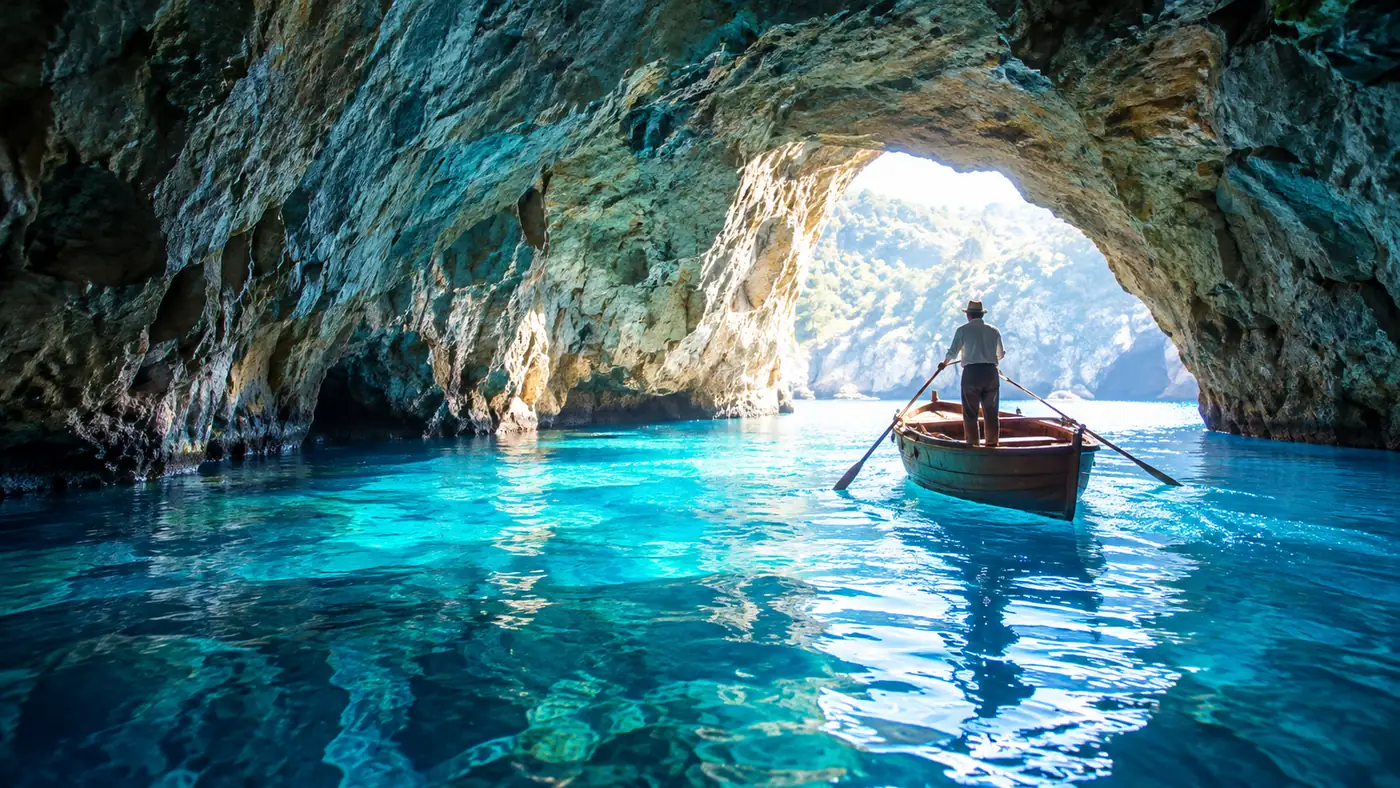
The chamber is about 60 metres long and 25 metres wide, with a vault averaging around seven metres and rising to fourteen. You enter lying flat, because the mouth stands about a metre above the waterline, and the rower pulls on a chain fixed to the rock. Then the water is lit, and it is lit from below.
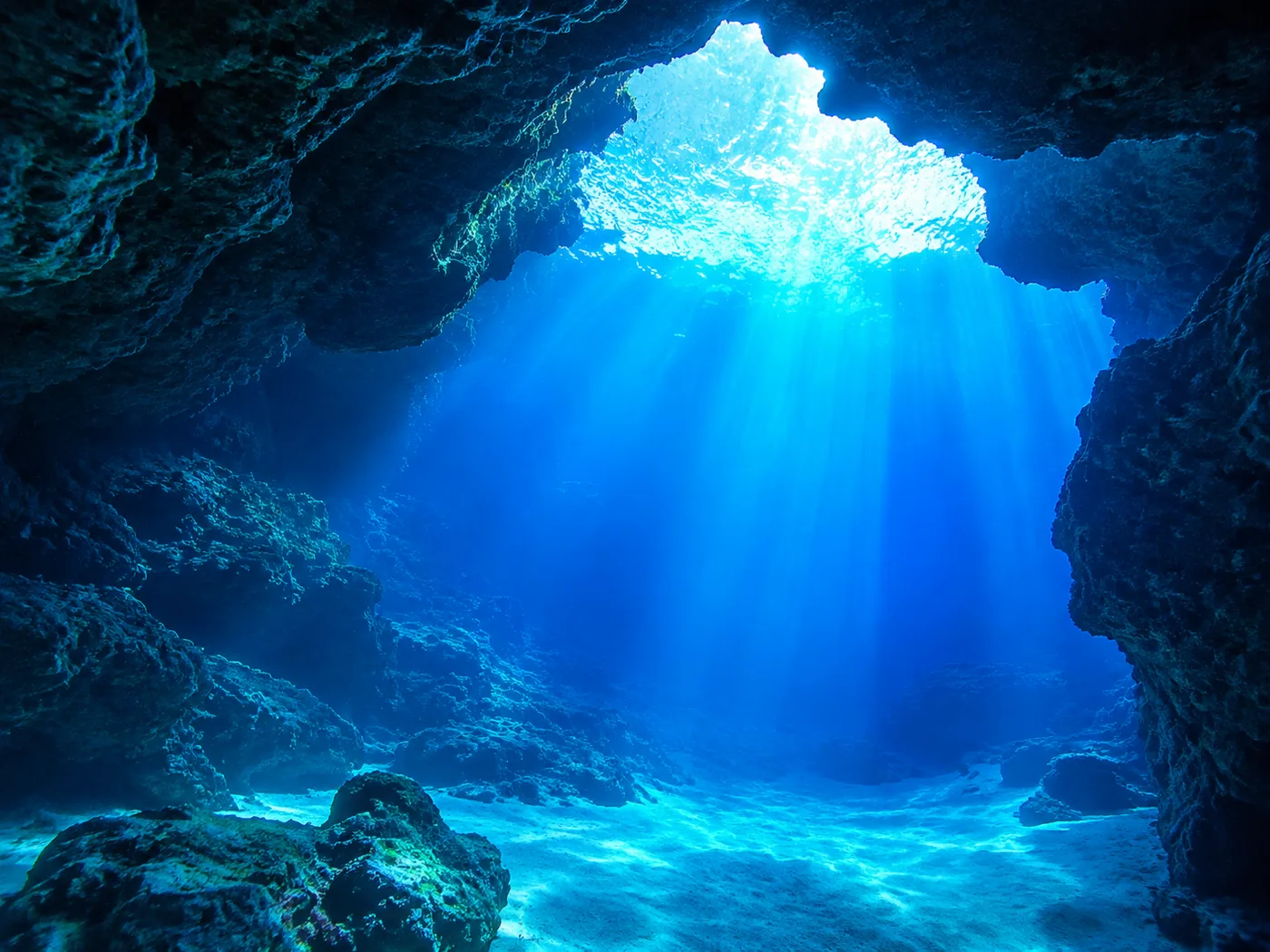
That is the part worth having in your head before you go, because it is the part almost nobody explains. A second opening, much larger than the visible one, sits underwater beneath the entrance, separated from it by a band of rock. Sunlight passes through several metres of seawater to reach it. Seawater absorbs the red end of the spectrum and lets the blue through, so the light arriving in the chamber from underneath has already had the red taken out of it. The common explanation, that light refracts through the entrance you can see, is incomplete. The window that matters is the one you cannot see.
Two consequences follow, and both are good detail to carry in. Objects held underwater turn silver, because air bubbles cling to them and catch the light from below. Mark Twain noticed it in 1869. And a dead-flat sea actually weakens the effect, because the submerged window needs some movement on the surface outside to transmit light through it. The cave wants a sea with a little life in it. The mouth wants a sea with almost none. That narrow gap between the two is most of what this site is about: the morning you come on decides more than the month you come in.
It was a Roman room before it was an attraction
The cave was fitted out as a maritime nymphaeum, a decorated water room, belonging to the Villa di Gradola directly above it. Not the Villa Damecuta, which is a different villa and gets substituted for it constantly. That it belonged to Tiberius is a traditional attribution, and the Ministry of Culture flags it as traditional rather than established, which is the correct way to hold it.
Statues came out of the water: Neptune, two Tritons and a female figure in a peplos, recovered between 1964 and 1975. They are now in the Museo Archeologico di Capri at the Certosa di San Giacomo, which opened in July 2024, and they are not in the Casa Rossa, whatever an older guidebook tells you. A survey in 2009 found seven statue bases, which means up to four more figures may still be on the cave floor. In February 2024 divers brought up a carved block from about three metres down. So the room is not finished being excavated, which I find is the thing that changes people’s minds about the four minutes.
Behind the main chamber there are side rooms. The Sala dei Nomi carries visitor graffiti from the eighteenth and nineteenth centuries. There is a Galleria dei Pilastri, and a Sala della Corrosione, where exploration stops because the air is not breathable. You do not see any of them from the rowboat. I mention them because the cave is larger and stranger than the four minutes suggest, and because the passages at the back are natural fissures that narrow and dead-end. There is no Roman tunnel up to a villa. That story is invented.
1826 was a rediscovery, not a discovery
August Kopisch and Ernst Fries were taken into the cave on 17 August 1826 by a Capri fisherman named Angelo Ferraro. The cave had never been lost. Islanders knew it as the Grotta di Gradola, and it appears on a map in Coronelli’s Isolario of 1696. What kept locals out was superstition rather than ignorance: la grotta maledetta, the cursed cave. The Ministry of Culture itself uses the word riscoperta, rediscovery, which is the only honest word for it.
That makes 2026 the bicentenary. The Ministry announced an exhibition on 3 July 2026, Il mito di Capri, a duecento anni dalla scoperta della Grotta Azzurra (1826–2026), at the Certosa di San Giacomo, where the statues are. If you are coming this year and the sea shuts the cave on your morning, that exhibition is the one consolation on the island that is actually related to what you came for. It is also indoors.
The cave got a copy. Ludwig II of Bavaria had the Venus Grotto built at Linderhof between 1875 and 1877 in imitation of it, and the paint colour called Capri blue takes its name from here. Two hundred years of people trying to take the light home with them.
The three cases where I say no
These are not hedges. They are the three conversations I have had most often, and in all three I have told the visitor to skip it.
One. You have a single day on Capri and have not seen the island yet. The grotto is not a stop you add to a day. From Marina Grande it is realistically two hours door to door once the queue is counted, and from the centre of Anacapri I would budget an hour and a half to two. That is a substantial piece of one day, spent to be inside for four minutes, on an island where the boat circuit and the town are the things people actually remember. If the day is short, the cave is the wrong thing to spend it on.
Two. Stairs, small boats or lying flat are a problem. The Ministry classifies the site as partially accessible, and I would treat that as not step-free. From the road above there is a flight of stairs down to the landing. You then transfer into a rowboat that takes four passengers, and you lie flat on your back to clear a mouth about a metre high. If you arrive by sea you also wait offshore in a small boat rather than on solid ground, which is the version that makes people ill. No official source publishes more accessibility detail than that phrase, and I am not going to invent any.
Three. The day is pre-paid and cannot move. The skippers decide at the cave mouth at nine in the morning whether it is safe to go in. There is no way to know the night before, and it is normal for the cave to open and close again inside the same day. The €6 and the €12 are paid at the cave, so a closure costs you nothing there. What is exposed is anything you pre-paid: a motorboat transfer, or a tour. I could not find a published refund policy from any of the boat companies, so I will not tell you what happens to that money. Ask at the ticket desk before you hand it over. The whole closure picture is on hours and why it closes.
What works
- A Roman nymphaeum lit through a submerged opening, which is genuinely unusual
- Statues from it are on the island, at the Certosa, and up to four more may still be down there
- 2026 is the bicentenary, with a Ministry exhibition at the Certosa
- By land it is €18 and needs no booking at all
- The €6 and €12 are paid at the cave, so a closed day costs you nothing there
Worth knowing
- Under five minutes inside, and the rower will not slow down
- 60 to 90 minutes of queue in summer, sometimes over two hours
- €41 to €42 from Marina Grande, which is the way most people arrive
- Nothing on sale anywhere moves you up the rowboat queue
- Closed whenever the sea is wrong, decided that morning
Is it a tourist trap
A trap is something sold to you under a false description. The entrance fee is a real state charge on a real archaeological site, and the €12 rowboat is a real, official, separate fare rather than a shakedown, which is the single most useful thing I can tell anybody who came away angry. Most of the people who believe they were cheated were meeting a lawful second charge they had not been told about. A tip on top of that fare is a different matter: it has no tariff, no policy and no obligation behind it, and the pressure to pay it is the part of the visit I like least.
So: not a trap, but consistently oversold. What gets sold is a wonder. What you get is four minutes of one, wrapped in ninety minutes of logistics, on a day the sea has a veto over. If you go in expecting that, I have never met anyone who regretted it. If you go in expecting the photograph, you will be the person on the bus.
If you go, go the cheap way first
The land route works, it costs €18 at the cave plus €2.40 for the bus, and it needs no tour and no booking. I have written it out in full on going without a tour, because it is the version nobody selling anything has an incentive to explain. Take a boat tour if you are coming over from the mainland for the day and want the crossing and the island circuit. That is a good day out. Just do not book it for the cave, because no tour on the market includes grotto entry and none of them can promise the cave will be open.
 Cheapest
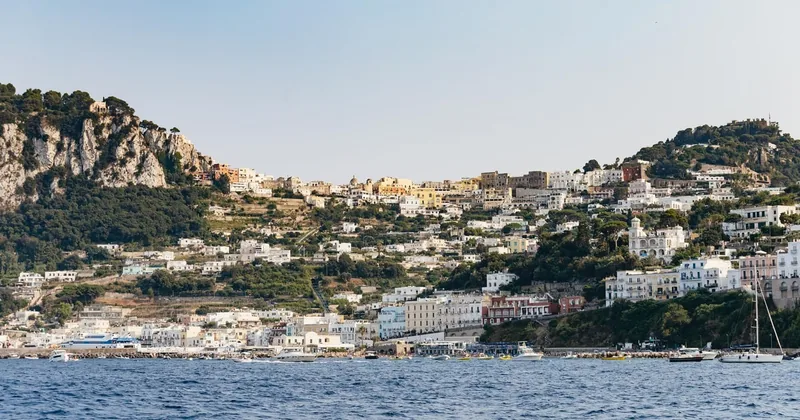
Capri: Island Boat Trip with Grottos
 Best rated
Sorrento: Exclusive Capri Boat Tour and Optional Blue Grotto
 Private boat
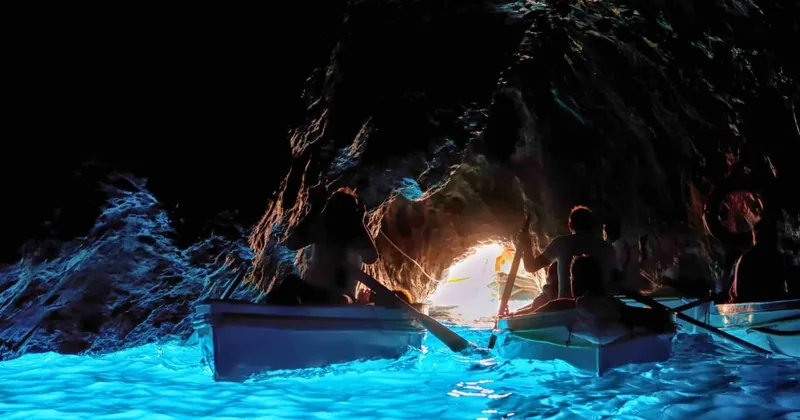
Capri: 3-Hour Private Boat Tour with Blue Grotto Visit
Frequently asked questions
Is the Blue Grotto worth visiting?
Yes, if you understand that you are paying for under five minutes inside a Roman nymphaeum lit through a submerged opening, and that the queue around those minutes runs 60 to 90 minutes in summer. It costs €18 by land from Anacapri and €41 to €42 by boat from Marina Grande. The full explanation is in the guide.
Is the Blue Grotto a tourist trap?
No, in the sense that the charges are real: €6 is a state entrance fee for an archaeological site and €12 is an official rowboat fare, not an improvised demand. It is oversold, though. The visit is four minutes long, the queue is not, and the tip request at the end has no official standing whatsoever.
Who should skip the Blue Grotto?
Three groups. Anyone with one day on Capri who has not yet seen the island, because the grotto eats two hours for four minutes inside. Anyone who struggles with stairs, small boats or lying flat, since the site is only partially accessible. And anyone whose day is pre-paid and cannot move, because the sea closes the cave without warning.
Is it worth booking a tour just for the Blue Grotto?
No. No tour includes grotto entry, so the €18 at the cave is still yours to pay, and nothing sold anywhere moves you up the rowboat queue. Book a boat tour because you want the crossing and the island circuit, and treat the cave as a stop that may not happen — the boat options are compared here.